





Scotland’s uplifting heritage
The rescued archives of Sir William Arrol and Co, builders of the Forth Bridge and iconic cranes, are an extraordinary record of prominent steel engineering structures worldwide.

|
| The two catalogues of the Sir William Arrol Collection, produced by RCAHMS in 1998 and 2000 from data compiled by Miriam McDonald (RCAHMS, now Historic Environment Scotland). |
Introduction
In 1987, the industrial heritage team of the Royal Commission on the Ancient and Historical Monuments of Scotland (RCAHMS) was alerted to an endangered archive of engineering records in an abandoned factory in Glasgow. The site was home to Sir William Arrol and Company, builders of the Forth Bridge (and the Forth Road Bridge 70 years later). My colleague Graham Douglas and I drove from Edinburgh to find a sad and chaotic scene. Scrap merchants had tipped the archives from their cabinets and the floor was covered with mounds of soiled photographs and drawings.
We filled the car and took what we could back to Edinburgh, where it could be cared for by our own collection, the National Monuments Record of Scotland (NMRS). We set about sorting and cataloguing it over several years, a process led by our colleague Miriam McDonald. We suspect that the scrap merchants may have taken some of most recognisable material because there were very few records of the Forth and Tay Bridges, or of Tower Bridge in London, Arrol’s most famous projects. However, what remained was extraordinary and was evidence of the global stature of the company.
Arrol led a structural engineering revolution that realised the potential of mild steel, a consistently reliable new material produced by the Siemens Martin process at much lower cost than had been achieved by Bessemer. The Forth Bridge was one of the first large-scale engineering structures to be built from this new material and mild steel remains a mainstay of the construction industry today.
The rescued archives became the Sir William Arrol Collection, now held by Historic Environment Scotland. It is an extraordinary record of prominent steel engineering structures all over the UK and across the world. It took a great deal of research to identify many of these structures and we were greatly indebted to Brian Newman of Newcastle University, who helped us identify images and sites.
Among the collection were photographs and drawings of iconic shipyard cranes. These prominent structures have become strongly associated with Glasgow and the River Clyde, but other examples exist across the world. By chance, Brian had completed his PhD on ‘Giant cantilever cranes’ and had consequently learned a great deal about Arrol. He was the perfect person to help with the collection. Early on, he was particularly impressed with a photograph of the jib of a crane that had been assembled at Arrol’s Parkhead in around 1912. This extraordinary image captures an inspection team from the Japanese Imperial Navy, to whom the crane was about to be shipped. The 250-ton crane was then transported to Japan and erected in the Sasebo Dockyard in Kyushu.
Brian was able to clarify many issues relating to Giant cantilever cranes. First, he established that these were not ‘hammerhead’ cranes, which are entirely different cranes associated with German competitors. Equally, although some Arrol drawings bear the name Titan, they are not Titans either. We were able to establish that they are ‘Giant cantilever cranes’, that they are uniquely British, and that the design originated in Scotland. They are, in fact, Glasgow’s Giants, and most of them were indeed built on the Clyde, many by Sir William Arrol. Brian’s research traced their origins back to the Glasgow Crane and Electric Hoist Company, whose prototype was built for MacColl and Pollock’s shipyard in, Sunderland, England. They merged with Appleby Ltd (also of Glasgow) in 1906 and then won the contract to build a 150-ton crane for the Mitsubishi Shipyard in Nagasaki. That crane was erected on their behalf by the Motherwell Bridge Company in 1909. A year later, Appleby merged with Sir William Arrol and Company, confirming Glasgow as the main centre of crane production at that time.
The importance of the Giant cranes can not be overstated. Apart from being iconic, prestigious structures that enhanced the image and presence of shipyard businesses, they performed a vital function and changed the way ships were built. Key attributes included their capacity to lift much heavier loads using electric motors, and their ability to do so with great accuracy. They therefore permitted the lifting and installation of hugely valuable loads such as marine engines, boilers, steering gear, storage tanks, guns and gun turrets, prefabricated sections and funnels. Any error when lifting these types of loads could cause costly damage both to the items being loaded and the structure of the ship’s hull.
Given the success of the design and a surge in demand, other British engineering companies were licenced to build Giant cranes. These included Babcock and Wilcox of Renfrew, Cowans Sheldon of Carlisle, and Stothert and Pitt of Bath. However, Arrol was by far the most prolific builder, and it was this company that built the oldest surviving example (1908) at John Brown’s Shipyard in Clydebank. Appleby completed its Nagasaki crane in 1909, shortly before being taken over by Arrol. This crane is still being operated by Mitsubishi, and was included in the successful Unesco world heritage nomination of the Sites of Japan’s Meiji Industrial Revolution in 2015, in the same session as the Forth Bridge.
After the success of the Mitsubishi crane, Arrol went on to build a crane of double the capacity just along the coast from Nagasaki at Sasebo in 1913. This was the crane featured in the photograph we found in the factory. Astonishingly, this is also still operational, having been well maintained by the subsequent occupiers of the shipyard. However, overall, these two inspiring Japanese examples are an exception. Brian estimated that between 50 and 60 Giant cantilever cranes were constructed across the world. Of these, he believed (before his untimely death in 2021), only 12 survive. Half of these are in the UK, two in England and four in Scotland.
The conservation challenge
Much of what Sir William Arrol built was constructed from mild steel. Although it is a strong, versatile material, it requires maintenance to prevent decay, especially in areas where water gathers and is unable to drain or evaporate. Even with protective coatings such as the Forth Bridge’s red paint, vulnerable areas will suffer from potentially dangerous rust over time. Giant cranes are no exception, and the problem is exacerbated by their scale, exposure, elevation and maritime location. Equally, the multi-coat system recently used on the Forth Bridge renovation required the removal of all the old paint layers and was very expensive.
For most Giant cranes, viable maintenance has been possible only if they have remained operational. This is why the two Japanese cranes have survived, and why the Arrol-built Walker Crane (1931) still stands proudly on the banks of the Tyne, having been uprated from 250- to 350-ton capacity. Elsewhere, the cost of maintaining the cranes has been seen as too great. The Giants in places like Rosyth, Vickers in Barrow and even BAe’s Fairfield Shipyard, have all been lost, despite some having statutory protection.
Today the largest cluster of Giants survives, appropriately, on the River Clyde. All are disused, and include the Arrol cranes at John Brown (Clydebank, 1908), Barclay Curle (Whiteinch, 1917), James Watt Dock (Greenock, 1920) and the Finnieston Crane (Stobcross, 1932). All are prominent riverside features and all exhibit varying degrees of distress. All require urgent intervention, but the hugely impressive conservation job done on the Forth Bridge is beyond the means of their current owners. Glasgow’s Giants are in fact the tip of the steel-conservation iceberg. Across the world there are prominent steel structures, often major pieces of infrastructure like railway bridges, that are in urgent need of maintenance. In many cases there are insufficient resources for a comprehensive maintenance regime, so the question arises as to the potential for a more targeted conservation approach.
It was this possibility that brought my organisation, TICCIH, into contact with conservation scientists in Germany (Heritage Conservation Centre, Ruhr in Bochum) and with a company called Termarust in Quebec, Canada, promoting new types of steel coatings. These, based on HRCSA (high-ratio co-polymerized calcium sulfonate), involve the targeted cleaning of areas of severe corrosion and the subsequent application of HRCSA-based coatings, which drive out the dangerous moisture and arrest corrosion. Termarust claims to have very significantly extended the life of many bridges across North America, and now research is being conducted in Europe to test out the new coatings.
Glasgow’s own Giants will no doubt perish if nothing is done. The Barclay Curle crane, for example, looks especially vulnerable. It would be fantastic if the HRCSA coatings could be tested out on these cranes. If successful, the outlook for steel-built heritage across the UK and beyond would, without doubt, be uplifting.
This article originally appeared in the Institute of Historic Building Conservation’s (IHBC’s) Context 186, published in December 2025. It was written by Miles Oglethorpe, the former head of industrial heritage at Historic Environment Scotland, and president of TICCIH (International Committee for the Conservation of the Industrial Heritage).
--Institute of Historic Building Conservation
Related articles on Designing Buildings Conservation.
IHBC NewsBlog
IHBC sponsors Gardens Trust event 23-4 Sept 2026
.jpeg)
'Learning from the Past, Shaping the Future’ takes place in Milton Keynes
Renovations to Frank Lloyd Wright's Fallingwater complete
.jpg)
World Heritage Preserved project opens house for tours again
Shakespeare Birthplace Trust places Hall's Croft on HAR Register
Stratford-upon-Avon home of Shakespeare's daughter is 'At Risk'
Lady Grange’s House repaired on St Kilda
.jpg)
National Trust for Scotland repairs stone cleit with link to famous island resident
Griff Rhys Jones on BBC Radio 4 Today programme
,_Green_Lane,_Derby.jpg)
The Victorian Society’s President unveiled its latest Top Ten Endangered Buildings 2026.
Need a MATE? Book your place now.

IHBC offers free webinars on applying for IHBC accreditation (Full & Associate).
UK Stained Glass Repository finds windows new homes

How are stained glass windows are rescued, stored and repurposed?
APPGEBE report sets high aims for quality
'Government must not sacrifice quality in drive to build 1.5m homes'
New measures protect Historic Shipwrecks from heritage crime

Underwater cultural heritage benefits from new HE guidance
How could the City of London skyline look in 6 years' time?

Visualisation shows approved planning applications as completed buildings
National Trust for Scotland calls for VAT cuts

Heritage neglect is encouraged by current policies
IHBC's 'Context' Issue 186 features Industrial Heritage
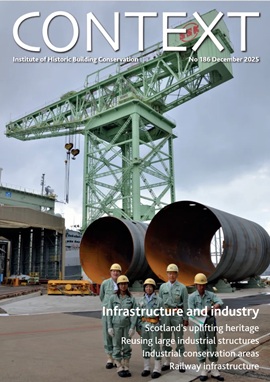
IHBC's members' journal reports on the challenges of conserving infrastructure
Book now for IHBC Annual School 2026

IHBC Annual School is taking place 18-20 June 2026 in Newcastle
RICHeS Research Infrastructure offers ‘Full Access Fund Call’
RICHeS offers a ‘Help’ webinar on 11 March
Latest IHBC Issue of Context features Roofing
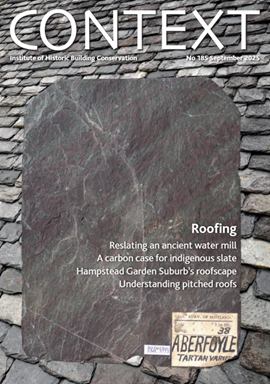
Articles range from slate to pitched roofs, and carbon impact to solar generation to roofscapes
Three reasons not to demolish Edinburgh’s Argyle House

Should 'Edinburgh's ugliest building' be saved?
IHBC’s 2025 Parliamentary Briefing...from Crafts in Crisis to Rubbish Retrofit
IHBC launches research-led ‘5 Commitments to Help Heritage Skills in Conservation’
How RDSAP 10.2 impacts EPC assessments in traditional buildings

Energy performance certificates (EPCs) tell us how energy efficient our buildings are, but the way these certificates are generated has changed.